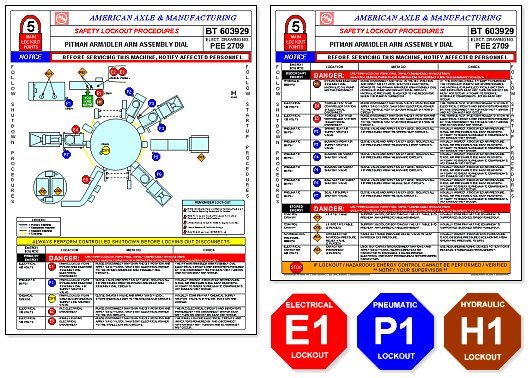
Every year, hundreds of workers suffer serious injuries during equipment maintenance—many due to unexpected startup or residual energy release. The solution? A robust lockout tagout (LOTO) program. But building one from scratch takes time, expertise, and regulatory awareness. That’s why professionals across manufacturing, facilities, and maintenance turn to a free lockout tagout procedures template to get started quickly and correctly.
This guide delivers not just access to usable templates, but actionable insight into how to implement, customize, and enforce LOTO procedures that meet OSHA standards and reduce workplace risk.
Why You Need a Lockout Tagout Procedures Template
Templates aren’t shortcuts—they’re frameworks built on compliance logic. A well-designed lockout tagout procedures template helps you:
- Standardize shutdown, isolation, and verification steps
- Reduce miscommunication during maintenance
- Train new employees faster
- Pass OSHA audits with documented controls
- Minimize downtime due to procedural errors
Without a template, organizations often rely on memory or inconsistent notes. That leads to incomplete lockouts, skipped verification, or improper re-energization—common root causes in OSHA-cited incidents.
Real-world example: A plant in Ohio reported an amputation when a conveyor restarted during belt adjustment. Investigation revealed no written procedure existed. The fix? A standardized LOTO template rolled out across all production lines.
Templates provide consistency. But not all are created equal.
What Makes a Good Lockout Tagout Template
A high-quality LOTO template includes more than just “turn it off and lock it.” It structures the full energy control lifecycle. Look for these core components:
Key Elements of an Effective Template
| Section | Purpose | Example |
|---|---|---|
| Equipment ID | Identifies the specific machine | Hydraulic Press #4 |
| Energy Types | Lists all energy sources (electrical, pneumatic, etc.) | 480V electrical, hydraulic pressure |
| Isolation Points | Specifies lockable disconnects or valves | Main disconnect, hydraulic valve block |
| Lock Application Steps | Step-by-step shutdown and locking sequence | 1. Stop machine, 2. Open disconnect, 3. Apply lock |
| Verification Method | How to confirm zero energy | Test start button, pressure gauge check |
| Authorized Personnel | Names or roles allowed to perform LOTO | Maintenance Tech A, Supervisor B |
| Group Lockout Section | Instructions for multiple workers | Each applies personal lock to group hasp |
| Release Procedure | Steps to safely re-energize | Verify area clear, remove tags, restore power |
A free template missing these elements may create a false sense of compliance. Always validate before deployment.
Where to Find a Reliable Lockout Tagout Template Free
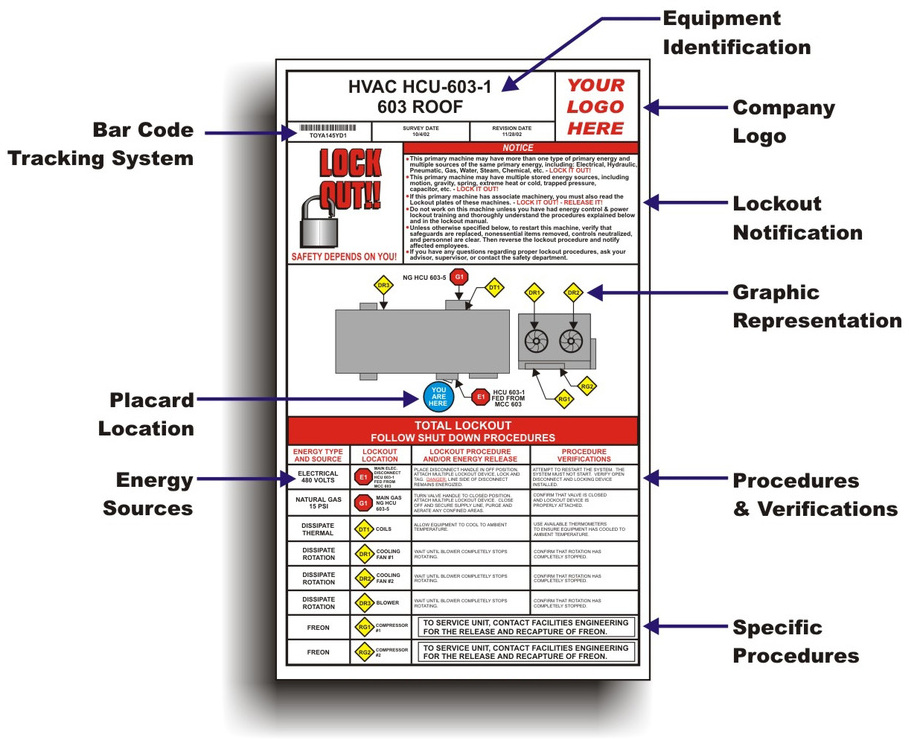
Many sites offer “free” LOTO templates, but quality varies. Some are generic PDFs missing customization fields; others are marketing traps requiring email signups. The best free templates come from trusted safety organizations or are used by real facilities.
Below are five vetted sources offering free, practical lockout tagout procedures templates:
1. OSHA Official Website
- Type: PDF and fillable forms
- Pros: Fully compliant with 29 CFR 1910.147
- Cons: Minimal formatting, requires manual customization
- Best for: Companies needing regulatory alignment fast
OSHA doesn’t sell templates but provides detailed examples in their publications. Their Control of Hazardous Energy guide includes sample procedures you can adapt.
2. National Safety Council (NSC)
- Type: Downloadable Word templates
- Pros: User-friendly, includes checklists
- Cons: Registration required for full access
- Best for: Mid-sized operations with training needs
The NSC offers LOTO templates as part of safety toolkits, often updated for real-world usability.
3. Grainger Safety Resources
- Type: Fillable PDFs and editable documents
- Pros: Clean design, includes lockout log sheets
- Cons: Branding on some documents
- Best for: Facilities using Grainger for PPE or locks
Grainger provides no-cost safety templates, including multilingual LOTO forms.
4. SafetyNow
- Type: Editable Word and Excel templates
- Pros: Includes training sign-offs and audit sections
- Cons: Limited public access; some content gated
- Best for: EHS managers needing documentation depth
Their free sample templates cover procedure writing, employee training logs, and equipment-specific forms.
5. TemplateLab
- Type: 20+ downloadable formats (Word, PDF, Pages)
- Pros: Wide variety, visually polished
- Cons: Mix of quality; some lack OSHA precision
- Best for: Small businesses wanting options
Search “lockout tagout template” on TemplateLab to find editable versions with placeholders.
✅ Pro Tip: Always cross-check any free template against OSHA 1910.147’s eight required elements: preparation, shutdown, isolation, lockout/tagout application, stored energy dissipation, isolation verification, servicing, and restoration.
How to Customize a Free Template for Your Facility
A generic template won’t protect your team unless it’s tailored. Here’s how to adapt one effectively:
Step 1: Identify Equipment and Energy Sources Walk through each machine with maintenance staff. List every energy type: electrical, mechanical, hydraulic, pneumatic, chemical, thermal. Don’t overlook springs or gravity-fed systems.
Step 2: Map Isolation Points Note the exact location of disconnects, valves, or bleed points. Include photos if possible. A LOTO procedure for a CNC machine should specify “Main 3-phase disconnect on rear panel, 6 o’clock position.”
Step 3: Assign Roles and Responsibilities Define who is authorized (trained LOTO performers) and who is an affected employee (operators who don’t perform maintenance). Only authorized personnel apply locks.
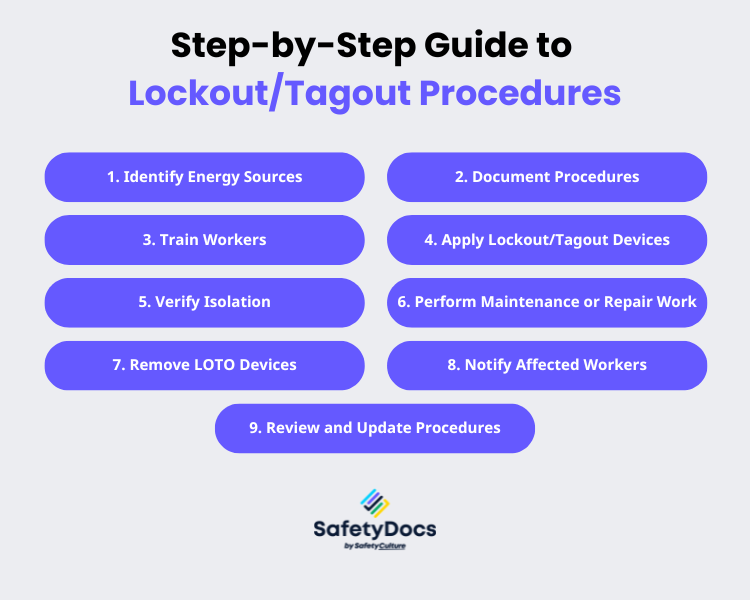
Step 4: Add Verification Language Avoid vague terms like “ensure power is off.” Replace with actionable steps: > “Press the ‘Start’ button to verify machine does not energize. Confirm voltmeter reads 0V at terminal block.”
Verification is where most failures occur.
Step 5: Integrate with Training Print the finalized procedure and use it in hands-on training. Have employees follow it during a mock lockout. Document completion with signatures.
Common Mistakes When Using Free LOTO Templates
Even with a solid template, implementation errors can create risk. Watch for these:
- Copying a template without reviewing energy sources
- → Result: Missing a hydraulic line that stores pressure
- Using one procedure for multiple machine types
- → Result: Incomplete isolation on a modified press
- Allowing tag-only use without locks
- → Tags can be removed; locks physically prevent startup
- Skipping group lockout rules
- → One worker removes locks before others finish
- Not updating procedures after equipment changes
- → Outdated isolation points lead to exposure
Real case: A technician was burned when a boiler re-pressurized. The LOTO template existed but hadn’t been updated after a control system retrofit. The isolation point listed no longer existed.
Templates reduce risk—but only if kept current.
Integrating LOTO Procedures into Daily Operations
A template isn’t a one-time download. It’s part of an ongoing energy control program.
Build These Habits:
- Conduct annual audits: Verify procedures match actual practice.
- Use lockout logs: Record each LOTO event, including date, equipment, and personnel.
- Review during near-misses: If a machine starts unexpectedly, revisit the procedure.
- Store procedures visibly: Keep laminated copies near equipment or in digital work orders.
Some companies use QR codes on machines that link to digital LOTO instructions—ideal for facilities using CMMS platforms.
Digital vs. Paper Templates
While paper templates are common, digital versions offer advantages: - Easier updates - Access via tablets on the floor - Integration with maintenance software
But ensure digital access is reliable. A dead tablet shouldn’t block a safe repair.
Making the Most of a Free Lockout Tagout Procedures Template
A free template is only valuable if it’s used correctly. Start by selecting one from a trusted source like OSHA or NSC. Customize it for each piece of equipment, involve your maintenance team, and validate it through practice.
Then, treat it as a living document. Review it annually. Train on it regularly. Audit its use.
Safety isn’t about paperwork—it’s about preventing harm. A solid LOTO template helps you do that systematically, without reinventing the wheel.
Download one today, but don’t stop there. Adapt it, enforce it, and make it part of your site’s safety culture.
Frequently Asked Questions
What is a lockout tagout procedures template? A standardized document outlining the steps to safely shut down and isolate equipment from all energy sources during servicing.
Are free LOTO templates OSHA-compliant? Some are, but not all. Always verify that the template includes all elements required by OSHA 29 CFR 1910.147 before use.
Can I use a tag without a lock? Only if the energy source can’t be locked out. Tags are warning devices; locks are physical restraints. OSHA prefers lockout.
Who should use the LOTO template? Authorized employees trained in energy control, typically maintenance and repair staff.
How often should LOTO procedures be reviewed? At least annually, or whenever equipment, processes, or workflow changes occur.
Do I need a separate template for each machine? Yes. Each piece of equipment has unique energy sources and isolation points. One-size-fits-all procedures are non-compliant.
Can I modify a free template for my facility? Absolutely. In fact, you must customize it to reflect your equipment, isolation points, and personnel roles.
FAQ
What should you look for in Lockout Tagout Procedures Template Free for Workplace Safety? Focus on relevance, practical value, and how well the solution matches real user intent.
Is Lockout Tagout Procedures Template Free for Workplace Safety suitable for beginners? That depends on the workflow, but a clear step-by-step approach usually makes it easier to start.
How do you compare options around Lockout Tagout Procedures Template Free for Workplace Safety? Compare features, trust signals, limitations, pricing, and ease of implementation.
What mistakes should you avoid? Avoid generic choices, weak validation, and decisions based only on marketing claims.
What is the next best step? Shortlist the most relevant options, validate them quickly, and refine from real-world results.